
×
Too tight
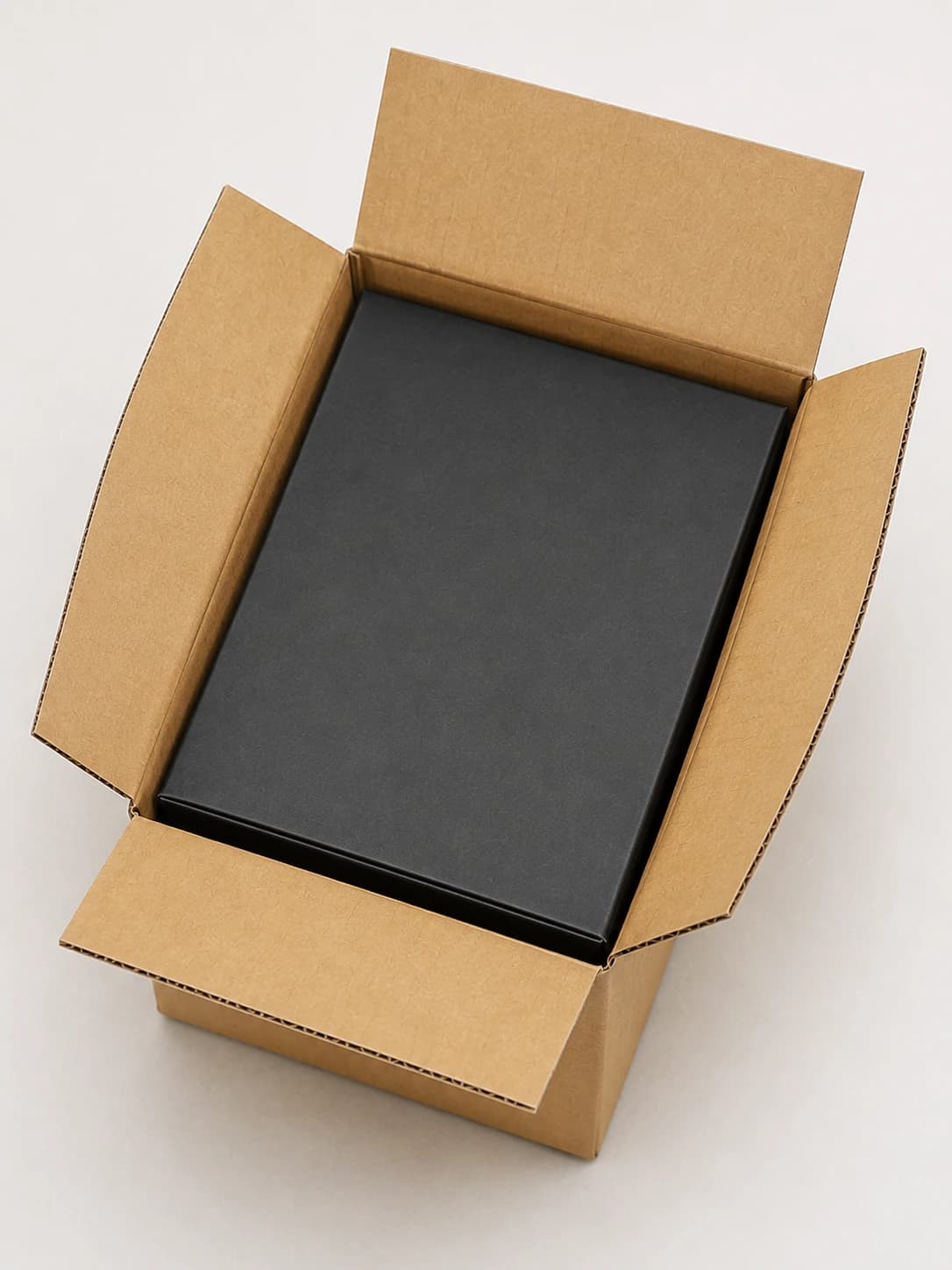
The product jams, packing slows down and the carton bulges. There is no room for inserts, tissue or a protective wrap.
Learn the simple L × W × H rule, understand internal versus external dimensions, and work out exactly what Pakko needs to manufacture packaging that fits your product.
Tap a dimension to see it on the box
Length — the longer dimension across the opening or base of the box. In 300 × 200 × 100mm, the length is 300mm.
Australian packaging manufacturer
Brisbane based
ISO 9001 accredited
Structural design in-house
The simple rule
Box measurements are written in one order, every time. 300 × 200 × 100mm means a length of 300mm, a width of 200mm and a height of 100mm. Select a card to highlight that dimension on the diagram above.
Remember this: always give dimensions in millimetres, in L × W × H order.
Internal vs external
This is one of the most common packaging mistakes. There is an important difference between the space inside the box and the finished size outside the box — cardboard has thickness.
Internal dimensions describe the usable space available for your product. When developing custom packaging with Pakko, these are usually the most useful measurements because they tell us what needs to fit inside.
The gap becomes more noticeable with heavier corrugated board, double-wall board or multi-layer packaging. Not sure which to send? Send both and label them clearly.
Cross-section of a carton wall: mint line shows which measurement internal figure refers to.
Choose your path
Pick the situation that matches yours and we will show the right steps. Nothing is hidden — you can read every path.
If you want an existing box reproduced, the internal cavity is what matters. Assemble the box first, then measure the usable space.
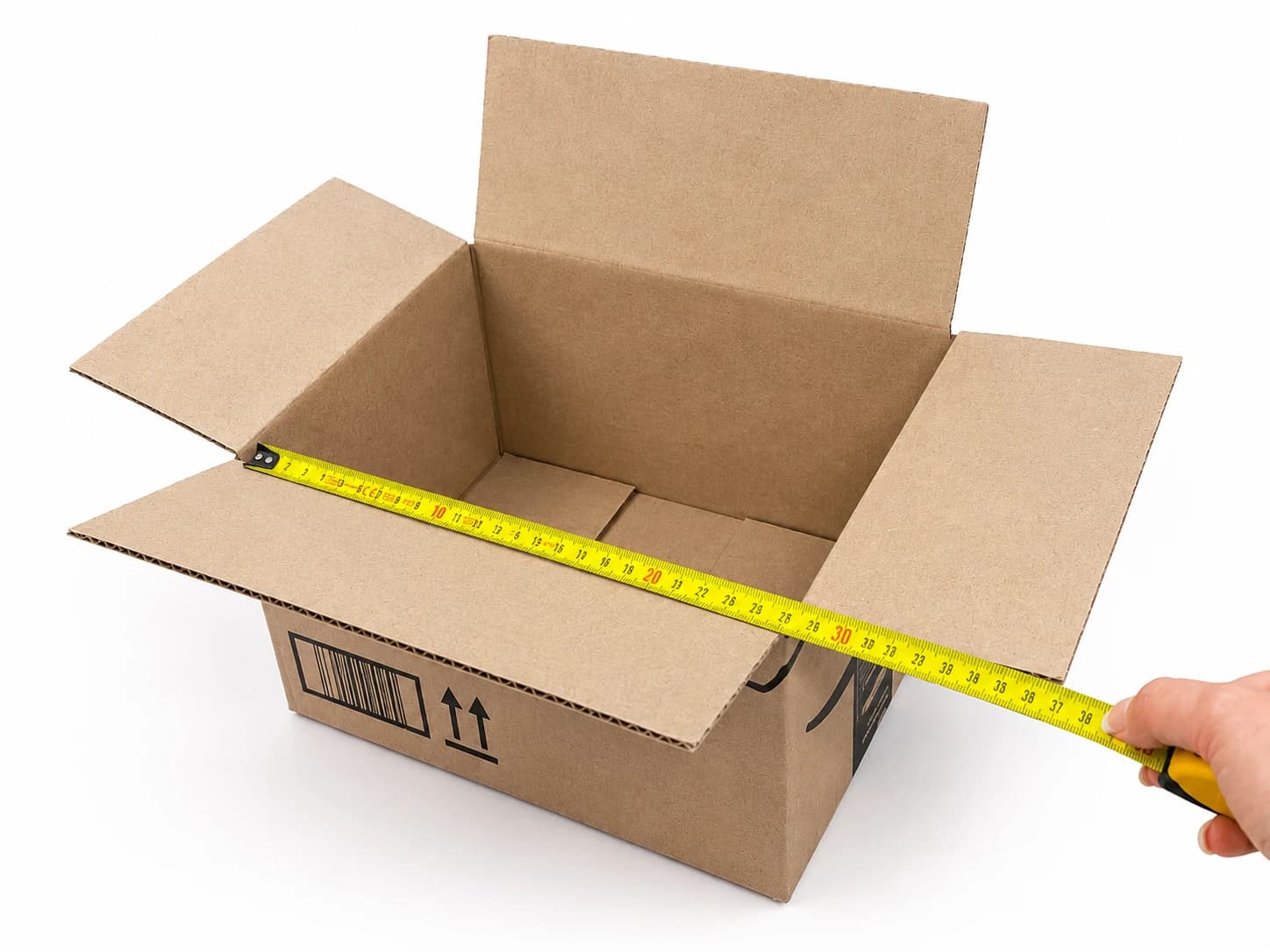
Even better, send Pakko
Box style explorer
Different constructions are measured differently. Find the closest structure to yours, then follow the three steps — and check what not to include.
Swipe for all seven box styles.
Reference photo
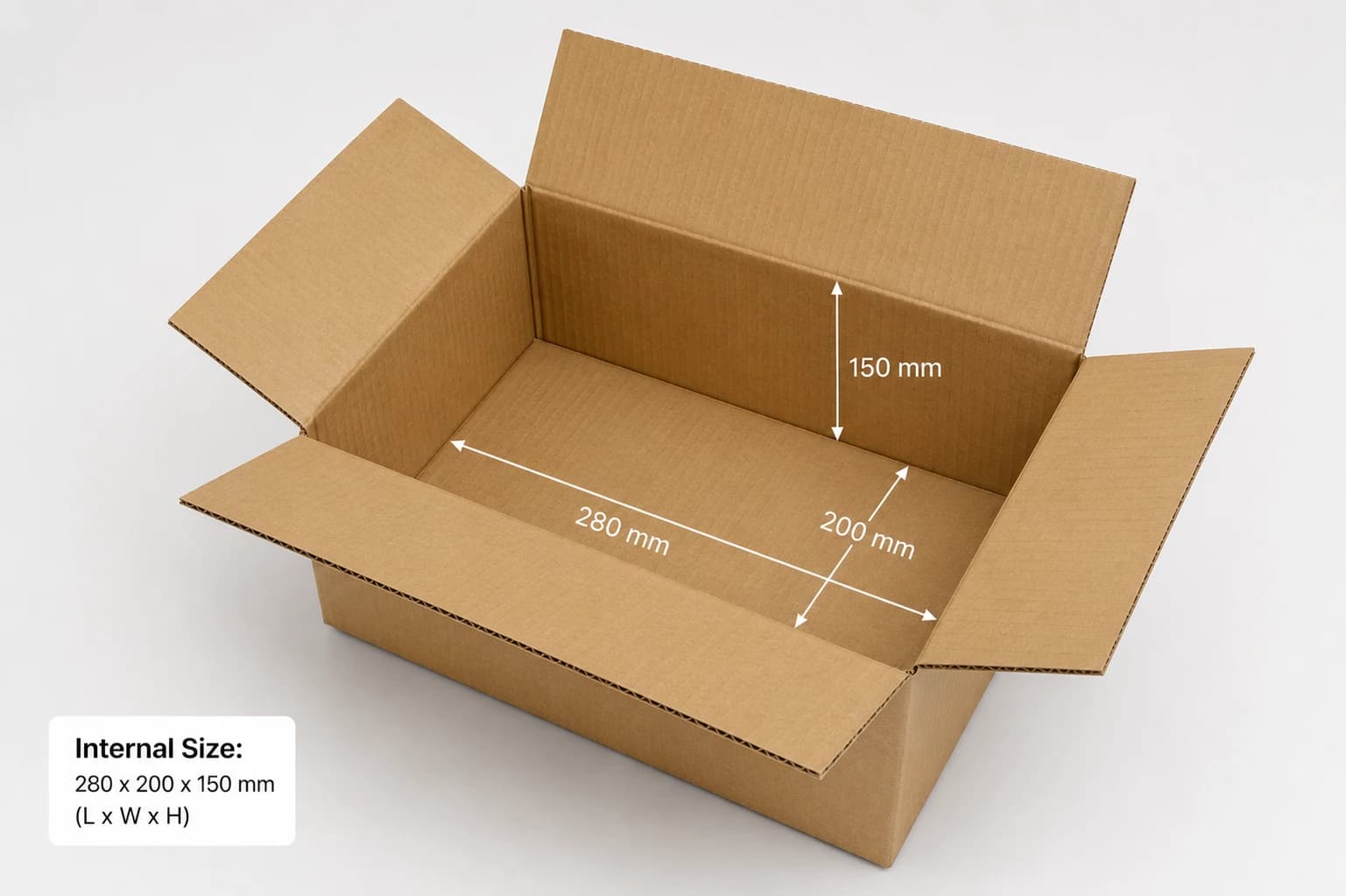
Regular Slotted Cartons are one of the most widely used transport boxes. Measure the internal cavity once the carton is assembled.
Longer opening dimension, measured inside the assembled carton.
Shorter opening dimension across the same opening.
Inside the base up to the top of the carton walls.
What not to measure
Closing flaps. They are part of the construction and are not added to the usable height.
Measure with the carton assembled — a flat blank will not give you the usable cavity.
Quote this styleShipping carton / RSC
Measure: Inside L × W × H
Do not include: Closing flaps
Mailer box
Measure: Usable internal L × W × H
Do not include: Locking tabs, wings and external folds
Tuck end carton
Measure: Internal main-panel L × W × H
Do not include: Tuck flaps and dust flaps
Box + lid
Measure: Base internal L × W × H
Do not include: Lid allowance — do not guess it
Sleeve
Measure: Dimensions of the item the sleeve fits around
Do not include: Treating sleeve as a normal cavity box
Carry handle
Measure: Usable body L × W × H
Do not include: Handle above the main product area
Spare parts / industrial
Measure: Product maximum L × W × H plus protection
Do not include: Weight, sharp edges and handling requirements
Fit and clearance
There is no universal clearance. The right allowance depends on the product, protection, inserts, board material and packaging structure.
The product jams, packing slows down and the carton bulges. There is no room for inserts, tissue or a protective wrap.
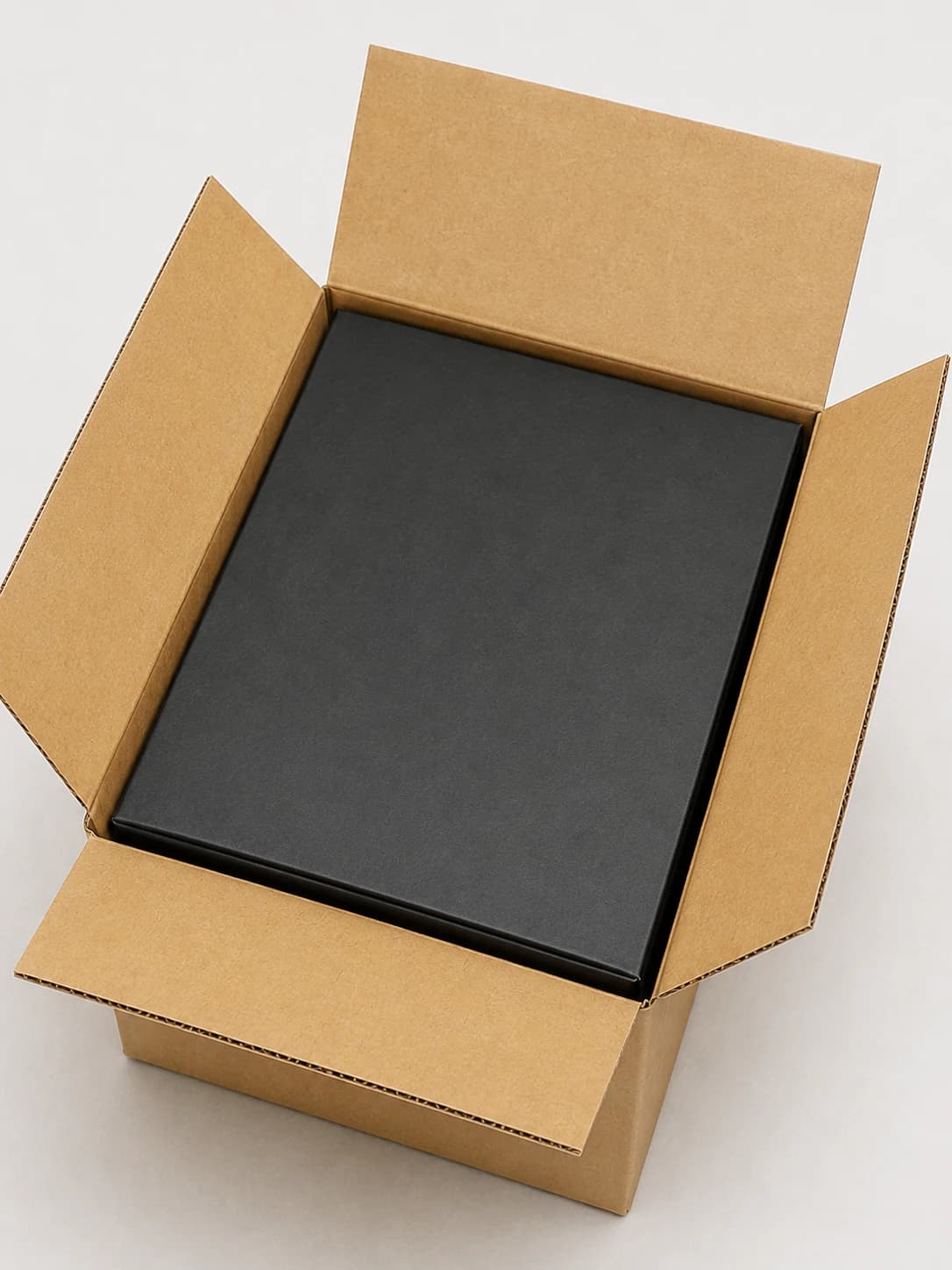
Enough clearance for protection and easy removal, without transporting air. Pakko can engineer this fit around your product.
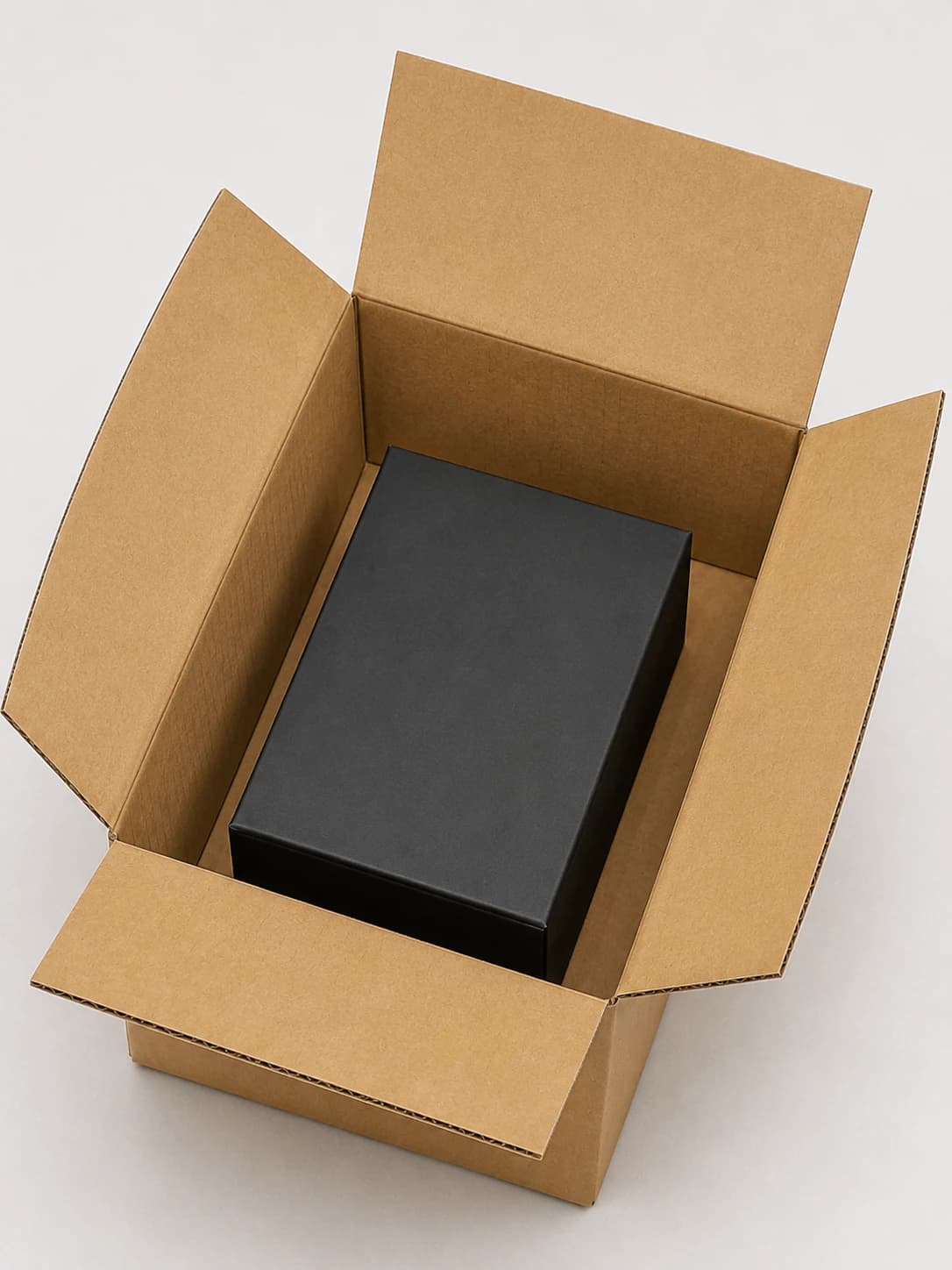
The product moves in transit, more void fill is needed and the parcel takes more space in storage and freight.
Cosmetics, pharmaceuticals, supplements and small retail products may require relatively precise dimensions. Packaging may also incorporate a custom insert to hold the product securely.
A mailer may need additional room for tissue, documentation or protective material while still keeping the contents secure during transport.
Fragile products may require more space for protective packaging or an engineered insert designed around the product.
Heavy products can require different board grades, box constructions and internal support — clearance is only part of the answer.
If several products are packed together, measure them in the exact configuration you intend to ship.
Irregular products
Imagine the smallest invisible rectangular box that can contain the entire product. Measure the maximum length, width and height to the furthest protruding points.
Select a protruding part to see what people commonly forget to include.
A handle can push the bounding box wider or taller than the body of the product. Measure from the outermost edge of the handle, not the body.
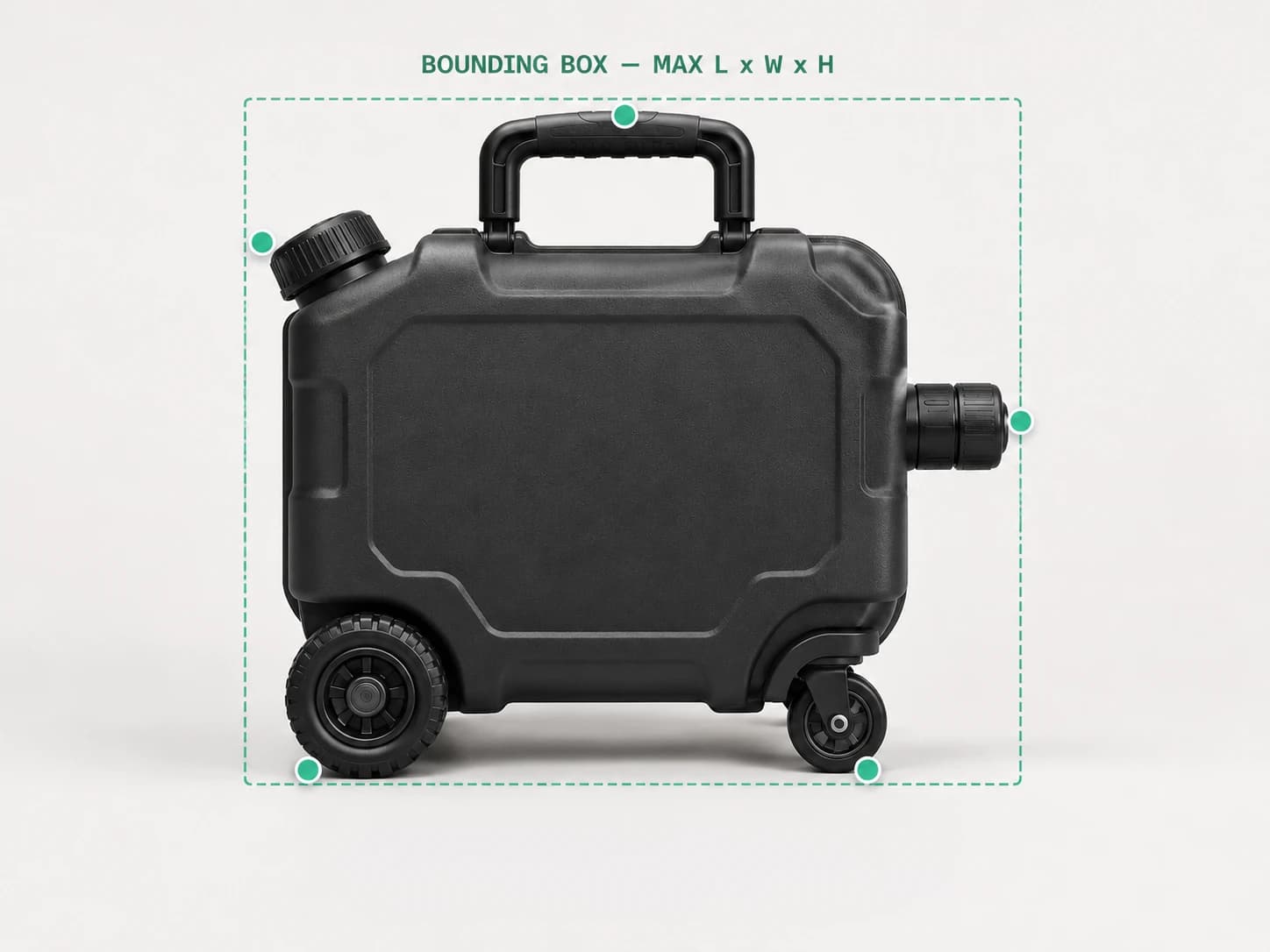
Measure to outermost points — including handles, caps, wheels, knobs and fittings.
The complete pack
One of the easiest mistakes is measuring only the hero product. Before deciding your finished box dimensions, arrange the full pack exactly as the customer will receive it.
Nothing selected yet
0 of 10 included
Start with the product, then add everything else that travels inside the finished box.
Volume calculator
Enter length, width and height in millimetres to estimate internal volume. Volume is useful for comparing box sizes, but it doesn't determine board strength or suitability.
Proportions preview
Internal volume
6litres
0.006 m³
300 × 200 × 100 mm = 6,000,000 mm³
Freight providers may consider parcel dimensions as well as weight when calculating cubic or dimensional weight. Packaging should protect the product without transporting unnecessary air.
Quote-ready checklist
Tick what you already have. You don't need every item to start — but the more you can tell us, the faster and more accurate the quote.
The essentials
Even better
You don't need to understand every technical packaging detail before contacting Pakko. That's part of what we're here to help with.
You do not need everything to contact us
If you know what the product is, roughly how big it is, what it weighs and how many you need, Pakko can help work through the rest.
Avoid these
Use Length × Width × Height — not height × width × length.
Tell us clearly which you are providing. For custom product packaging, internal is normally the best starting point.
Measure everything that needs to fit inside the finished package, not just the hero product.
If an insert, wrap or divider sits between the product and box, it needs to be considered.
Closing flaps are part of the construction and should not be added to your usable internal dimensions.
Provide accurate measurements in millimetres. Small differences matter with close-fitting retail cartons.
More space is not always better. The objective is the right amount of space for the product.
Different board grades have different thicknesses. Pakko accounts for this when converting internal dimensions into a manufacturable design.
FAQ
Yes. Packaging dimensions are commonly supplied as Length × Width × Height, written as L × W × H.
Packaging manufacturers commonly work from internal dimensions when the objective is determining how much usable space is inside the box. However, external dimensions are also important for freight, storage, palletisation and other applications. Always state which measurement you are providing.
For many standard rectangular boxes, length will be the longer dimension of the opening or main panel. For specialised packaging constructions, panel orientation can sometimes affect terminology, so providing a photo or dieline can help avoid confusion.
The terms are sometimes used interchangeably in packaging. Pakko generally uses Length × Width × Height to keep specifications consistent.
If you want an existing box reproduced, measure the internal dimensions of that box. If you are designing new packaging, start by measuring the product and everything that needs to fit inside it.
There is no universal answer. The correct allowance depends on your product, material, inserts, required protection and packaging style. For close-fitting custom packaging, Pakko can calculate the appropriate clearance during structural design.
No. Flaps are part of the box construction and normally are not included in the usable Length × Width × Height measurement.
Pakko works primarily in millimetres (mm) — for example, 320 × 240 × 85mm.
Yes. If you have packaging you would like reproduced or improved, send us the dimensions, photos or preferably an existing sample so we can assess the structure.
Measure its maximum Length × Width × Height and send Pakko photographs. For complex products, a physical sample may be the easiest way for our structural packaging team to design the correct solution.
It can. Freight providers may consider both physical weight and the amount of space a parcel occupies. Choosing appropriately sized packaging can therefore help reduce unnecessary packaging volume.
Yes. Provide the product dimensions, photographs, product weight and intended use and our team can help determine an appropriate packaging size and construction.
Keep learning
Still not sure?
Send Pakko a photo, your product dimensions or an existing packaging sample and our team can help determine what you need. Whether it's a printed retail carton, ecommerce mailer, shipping carton or complex custom packaging, getting dimensions right at the beginning makes everything easier.
Australian custom packaging, manufactured by Pakko in Brisbane.
Send your measurements and we'll get back to you within one business day.
Got your L × W × H?
Request a quote