When businesses start looking for custom cardboard boxes, price is usually one of the first things they want to understand. That is completely fair. Packaging is a regular business cost, and when you are managing stock, freight, wages, marketing and cash flow, every decision needs to make sense.
The challenge is that the cheapest packaging is not always the most cost effective packaging. A box that is too weak, too large, poorly designed or difficult to pack can end up costing more through freight, damages, returns, wasted labour and unhappy customers. The real goal is not just to find the lowest unit price. It is to find a box that does the job properly, without paying for things you do not need.
For many businesses, the most affordable custom box is the one that is designed with manufacturing efficiency in mind from the beginning. The more practical the structure, size, print and finish, the easier it is to keep costs under control.
One of the easiest ways to reduce the cost of custom boxes is to get the size right. A box that is larger than it needs to be will use more board, take up more room in storage and may increase freight costs. It can also require more void fill or packing material to stop the product moving around during delivery.
A box that is too small can create a different problem. It may be hard to pack, put pressure on the product or cause the packaging to fail in transit. If a customer receives a damaged product, the cost is no longer just the cost of the box. You are also dealing with replacement products, extra freight, staff time and customer service issues.
The most cost effective custom box should fit the product properly. It should allow enough space for protection, but not so much that you are paying for unnecessary material. This is where structural design matters. Small adjustments to the box dimensions can sometimes improve how efficiently it is made and how well it performs.
You can check this link out to see how to measure a box; https://www.pakko.com.au/learning-hub/how-to-measure-a-box
Custom does not always mean complicated. A simple, well designed box can often perform better than a more complex structure. If budget is a priority, it is worth asking whether the box needs extra features, unusual folds, inserts, windows or multiple components.
For ecommerce and shipping, a strong and practical structure may be more important than an elaborate design. For retail packaging, the presentation may matter more, but the structure still needs to be realistic for production, packing and handling.
A good packaging manufacturer should be able to guide you on whether a design is practical or whether there is a simpler way to achieve the same result. Sometimes a small change to the design can reduce material waste or make production more efficient, which can help lower the overall price.
It can be tempting to ask for the cheapest board available, but that is not always the best way to save money. The board needs to match the product and the way the box will be used.
A lightweight product may not need a heavy board. A fragile or heavier product may need stronger corrugated cardboard to handle stacking, freight and storage. If the board is too weak, the box may crush, split or fail. If the board is stronger than required, you may be paying more than necessary.
The best approach is to explain what the product is, how heavy it is, how it will be packed and how it will be shipped. From there, the packaging team can recommend a suitable material. This helps avoid over engineering the box, while still making sure it performs properly.
You can check this link out to understand different board grades; https://www.pakko.com.au/learning-hub/type-of-materials-we-offer
Print is one area where costs can change quickly. Full colour printed cardboard boxes can look beautiful and can help your brand stand out, but not every box needs heavy ink coverage or complex artwork.
If you are trying to keep costs down, consider whether a simple one colour print, a clean logo placement or a more minimal design could still achieve the right result. For some brands, a plain cardboard box with a strong printed logo can look professional, confident and intentional.
This does not mean printed packaging is not worth it. It often is, especially when the box is part of the customer experience or retail presentation. The key is to make the print work hard for your brand. Use print where it adds value, not just because every panel needs to be filled.
Foiling, spot UV, embossing, debossing, celloing and litho laminating can all create a more premium result. They can make packaging feel more polished, more luxurious and more memorable. They also add extra production steps, which can increase the cost.
If you are working within a budget, premium finishes should be used with purpose. For example, a foil logo on a high value product box may be worth the investment because it improves perceived value. But for a standard shipping carton, it may not add enough value to justify the cost.
The question to ask is whether the finish helps the product sell, improves the customer experience or supports the brand. If it does, it may be worthwhile. If it is simply a nice extra, it might be something to save for a later stage once the product or business has grown.
Learn more about the different print finishes: https://www.pakko.com.au/learning-hub/types-of-finishes
Quantity plays a major role in the unit price of custom boxes. Smaller runs can be useful when you are testing a new product, launching a new range or making sure the packaging is right before committing to a larger order. The downside is that smaller quantities often have a higher unit cost because setup and production preparation still need to happen.
Larger runs can reduce the unit price because those setup costs are spread across more boxes. However, ordering too much can also create problems if you do not have storage space, if your branding changes or if the product size is not yet final.
The cheapest option is not always ordering the largest amount. The smarter option is ordering a quantity that balances unit price, storage, cash flow and future flexibility.
One hidden cost in custom packaging is change. When artwork, sizing or structure changes late in the process, it can delay production and sometimes create extra costs. This is why it is important to check product dimensions, artwork files and design requirements before the job moves into production.
Providing clear information early makes the quoting and production process smoother. It also helps the packaging manufacturer recommend a better solution from the beginning.
If you are not sure what you need, it is better to discuss it early rather than guess. A short conversation at the start can prevent mistakes later.
For some businesses, the cheapest quote may come from offshore or from a supplier who is not actually manufacturing the boxes themselves. While that may work in some cases, it can also create challenges around communication, quality control, lead times, freight delays and minimum order quantities.
Working with a local cardboard packaging manufacturer in Brisbane can give you more visibility over the process. You can discuss the structure, board, print and finish with people who understand the production side. If something needs to be adjusted, it is easier to manage before it becomes a bigger issue.
Local manufacturing is not only about convenience. It can reduce risk, improve turnaround times and help businesses make better decisions with more confidence.
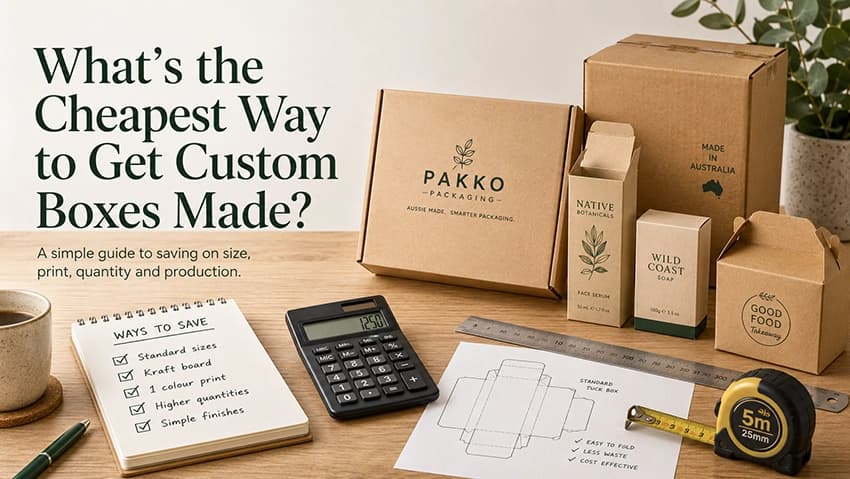
The cheapest way to get custom boxes made is to keep the design practical, use the right size, choose a suitable board, simplify the print where possible, avoid unnecessary finishes and order a quantity that makes sense for your business.
But the better question is: what is the most cost effective way to get custom boxes made?
That answer comes down to value. Your packaging needs to protect the product, suit your brand, be easy to pack and work within your budget. A cheap box that fails is expensive. A well designed box that performs properly can save money across freight, storage, labour and customer experience.
At Pakko, we help businesses create custom cardboard boxes that are practical, well considered and made locally in Brisbane. Whether you need plain cardboard boxes, printed packaging or a more premium finish, the right packaging should support your business, not create more problems for it.
FAQ
Are plain cardboard boxes cheaper than printed boxes?
In most cases, plain cardboard boxes are more cost effective because they involve fewer production steps. Printed boxes can add value when branding, presentation or customer experience matters, but the print should be chosen carefully to suit the product and budget.
Can I make custom boxes cheaper by ordering more?
Ordering a larger quantity can reduce the unit price because setup and production costs are spread across more boxes. However, it is important to consider storage space, cash flow and whether your product or branding may change before placing a large order.
What is the best way to reduce packaging costs without lowering quality?
The best way is to design the box properly from the start. Use the right size, choose the right material, keep the structure practical and only add print or finishes where they add value. This helps reduce waste while still protecting the product and presenting your brand professionally.